Mac mini M4 Buy vs Rent 2026: Total Cost, Break-Even at ~29 Days, and Who Should Choose Each
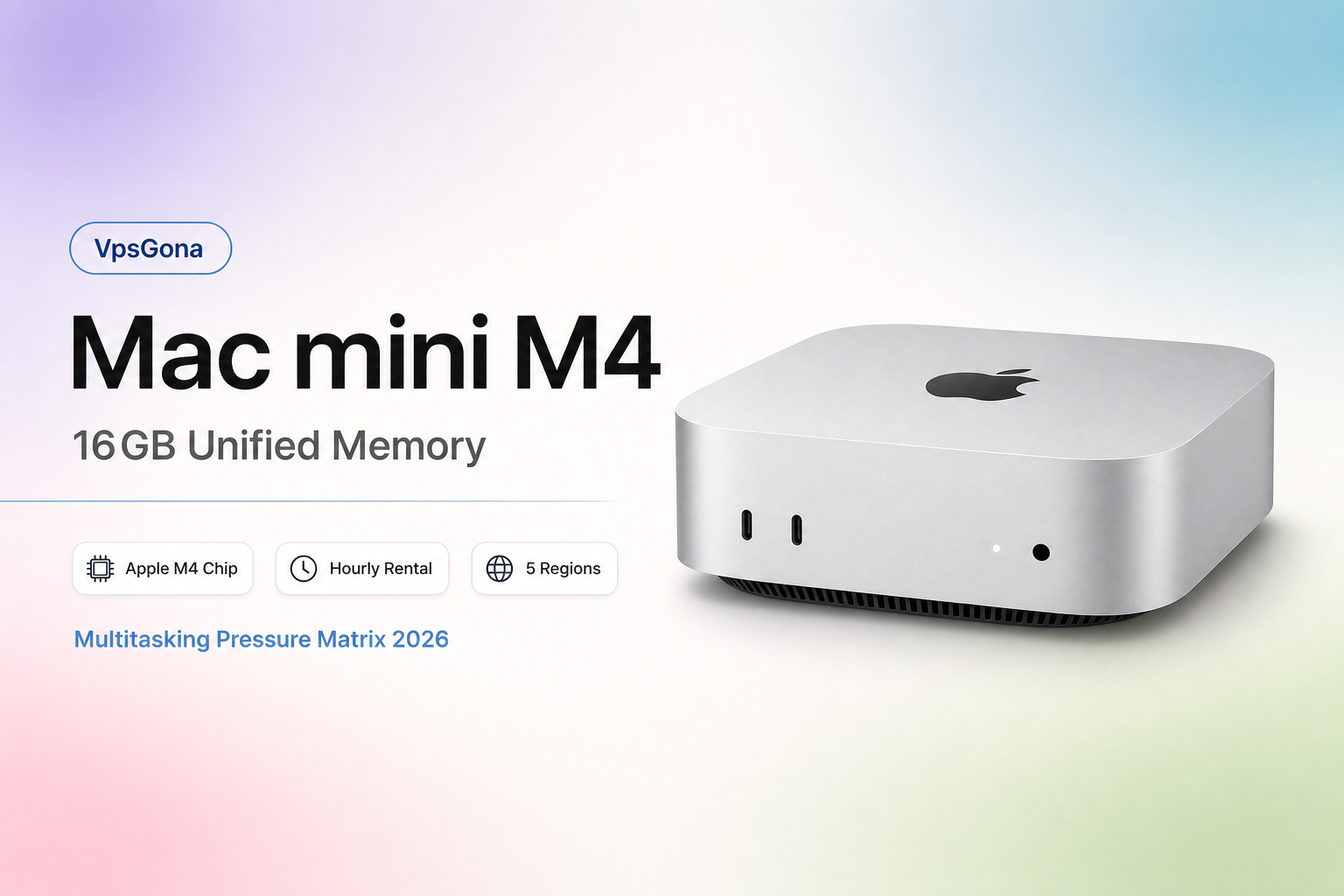
Deciding between owning a Mac mini M4 (16GB / 256GB) and renting a cloud node is a cash-flow question—not a benchmark contest. Apple lists the base M4 from $599 on the official Mac mini product page; VpsGona publishes $20.7/day, $103.5/month, and $281.5/quarter for the same class of hardware. This guide maps TCO, break-even near 29 rental-days, and the profiles where each path wins.
Waiting on 32GB/64GB BTO for Agents? See M5 Mac mini WWDC 2026 supply & DRAM delays (10–12 weeks on high RAM).
Tracking the M5 N3P vs M6 2nm GAA node war? See our Apple M5 N3P vs M6 2nm guide for FinFET vs nanosheet timing.
Disclosure: VpsGona is the Mac rental provider referenced in this article. Pricing data is sourced from VpsGona's published rate sheet and Apple's official website.
If you only need macOS for intermittent builds, reviews, or experiments, start with our on-demand rental cost guide—then use the duration framework in the rental duration guide to estimate active days before you compare purchase math below.
TCO snapshot: purchase vs VpsGona rental
Purchase (year 1). Hardware ~$599 plus accessories, shipping, and your time to rack, patch, and secure the machine. You carry depreciation, power, and the risk of idle capital whenever the box sits dark between sprints.
Rental (VpsGona). Published tiers: $20.7/day, $103.5/month, $281.5/quarter—billed for active rental time, not calendar ownership. You trade CapEx for OpEx and gain SSH-ready macOS without courier delays or desk clutter.
| Path | Upfront | Typical 30-day spend | Flexibility |
|---|---|---|---|
| Buy M4 16GB/256GB | ~$599 | $0 marginal if unused | Low—sunk hardware |
| Rent (daily) | $0 | ~$621.0 if used daily | High—release node anytime |
| Rent (monthly plan) | $0 | $103.5 | Medium—plan for bursts |
Real-world responsiveness for the base SKU is covered in our 16GB/256GB real-world test; node choice for short projects is in the short-term rental node guide.
Break-even math (~29 rental-days)
Simple break-even (hardware only): $599 ÷ $20.7/day ≈ 28.9 days → about 29 full-rate rental-days before buying wins on raw hardware TCO—if you would otherwise rent every single day.
Adjust downward when your true usage is sparse (weekends-only CI, quarterly App Store rescues). Adjust upward when you need multi-region latency testing across several nodes in parallel—rental can still beat one purchased box plus travel.
- Under ~29 active days/year: rental usually cheaper and faster to start.
- Over ~87 active days/year: purchase deserves a spreadsheet with power, desk space, and support hours.
- In between: hybrid—rent for spikes, buy only after a stable 90-day duty cycle.
Profiles where rent wins
- Bursty macOS needs: iOS archive weeks, not a daily driver—match spend to the duration decision window.
- Parallel experiments: two nodes for A/B toolchain tests without buying two Minis.
- Geographic latency checks: borrow a node profile from the latency benchmark before you standardize CI geography.
- Storage spikes without CapEx: finish large artifacts on a rented box; see 256GB vs 1TB storage trade-offs before you BTO a bigger SSD.
Profiles where buy wins
- Daily, all-day macOS: local IDE + always-on daemons—sunk $599 amortizes fast.
- Custom hardware footprint: lab instruments, PCIe enclosures, or air-gapped policies cloud cannot mirror.
- Strict data residency on your LAN: when code never leaves premises—rental is the wrong tool regardless of price.
- Long horizon + predictable load: >3× break-even days annually with stable power and space.
Hidden costs both sides ignore
Purchase hidden costs: downtime during OS migrations, failed drives, insurance, and opportunity cost of capital. A $599 box idle 280 days/year is not “cheap”—it is a depreciating asset.
Rental hidden costs: process discipline (snapshot secrets, tear down nodes), and egress habits if you sync huge artifacts repeatedly. Less CapEx, more operational hygiene.
Teams comparing SSD sizing often underestimate how quickly Xcode caches fill 256GB—our storage upgrade guide shows when to rent bigger temporary space vs buy TB BTO.
Decision matrix
| Signal | Lean rent | Lean buy |
|---|---|---|
| Active macOS days / year | < ~29 | > ~87 |
| Need 2+ nodes at once | Often | Rare |
| CapEx approval friction | High | Low |
| Latency discovery phase | Yes—use benchmarks | No—region fixed |
Still unsure? Run a two-week rental sprint using the cost guide bill model, log active hours, then multiply by $20.7. If the projected annual total exceeds ~$719 (hardware + hidden costs), model purchase—with eyes open about idle time.
FAQ
How many rental days equal buying a base Mac mini M4?
At VpsGona’s $20.7/day rate for a 16GB/256GB node, $599 ÷ $20.7 ≈ 29 active rental-days before purchase TCO wins—if you use the machine every day.
Is renting better for App Store submission sprints?
Yes—submission and review cycles are bursty. Renting lets you align spend with the sprint and pick a low-latency node for that window.
Does buying eliminate egress or npm issues?
No. Local hardware still depends on your ISP, export bandwidth, and registry mirrors. Cloud Mac nodes bundle datacenter-grade connectivity for remote builds.
What if I need 1 TB storage?
Buying a larger SSD raises upfront TCO. Compare upgrade math in our storage upgrade guide—or rent, finish the job, and release the node.
Rent only the days you need
Spin up a Mac mini M4 node for CI, Xcode, or review cycles—no hardware lock-in.